

To evaluate the health of your kidneys; to help diagnose kidney disease; to monitor the effectiveness of dialysis and other treatments related to kidney disease or damage
Blood Urea Nitrogen (BUN)
Blood Urea Nitrogen (BUN)
Also Known As
BUN
Urea Nitrogen
Urea
Formal Name
Blood Urea Nitrogen
This article was last reviewed
on
This article waslast modified
on July 11, 2018.
At a Glance
Why Get Tested?
When To Get Tested?
As part of a routine comprehensive or basic metabolic panel; when you have signs and symptoms that may be due to kidney disease or you have a condition that may cause or be worsened by kidney dysfunction; at regular intervals when you are being treated for kidney disease or damage
Sample Required?
A blood sample drawn from a vein in your arm
Test Preparation Needed?
None
Accordion Title
Common Questions
-
How is it used?
The blood urea nitrogen or BUN test is primarily used, along with the creatinine test, to evaluate kidney function in a wide range of circumstances, to help diagnose kidney disease, and to monitor people with acute or chronic kidney dysfunction or failure. It also may be used to evaluate a person's general health status when ordered as part of a renal panel, basic metabolic panel (BMP) or comprehensive metabolic panel (CMP).
Urea is a waste product formed in the liver when protein is metabolized. Urea is released by the liver into the blood and is carried to the kidneys, where it is filtered out of the blood and released into the urine. Since this is an ongoing process, there is usually a small but stable amount of urea nitrogen in the blood. However, when the kidneys cannot filter wastes out of the blood due to disease or damage, then the level of urea in the blood will rise.
The kidneys are a pair of bean-shaped organs that are located at the bottom of the ribcage in the right and left sides of the back. Within them are about a million tiny blood filtering units called nephrons. In each nephron, blood is continually filtered through a microscopic cluster of looping blood vessels, called a glomerulus. The glomerulus allows the passage of water and small molecules but retains blood cells and larger molecules. Attached to each glomerulus is a tiny tube (tubule) that collects the fluid and molecules that pass through the glomerulus and then reabsorbs what can be used by the body. The remaining waste forms urine.
If the creatinine and BUN tests are found to be abnormal or if someone has an underlying disease that is known to affect the kidneys, such as diabetes or high blood pressure, then creatinine and BUN tests may be used to monitor for kidney dysfunction and the effectiveness of treatment. Blood creatinine and BUN tests may also be ordered to evaluate kidney function prior to some procedures, such as a CT (computed tomography) scan, that may require the use of drugs that can damage the kidneys.
-
When is it ordered?
BUN is part of both the BMP and CMP, groups of tests that are widely used:
- As part of a routine health checkup
- To check how the kidneys are functioning before starting to take certain drug therapies
- When an acutely ill person comes to the emergency room and/or is admitted to the hospital
- During a hospital stay
BUN is often ordered with creatinine or renal panel when kidney problems are suspected. Some signs and symptoms of kidney dysfunction include:
- Fatigue, lack of concentration, poor appetite, or trouble sleeping
- Swelling or puffiness (edema), particularly around the eyes or in the face, wrists, abdomen, thighs, or ankles
- Urine that is foamy, bloody, or coffee-colored
- A decrease in the amount of urine
- Problems urinating, such as a burning feeling or abnormal discharge during urination, or a change in the frequency of urination, especially at night
- Mid-back pain (flank), below the ribs, near where the kidneys are located
- High blood pressure
BUN also may be ordered:
- At regular intervals to monitor kidney function in those with chronic diseases or conditions such as diabetes, congestive heart failure, and myocardial infarction (heart attack)
- At regular intervals to monitor kidney function and treatment in people with known kidney disease
- Prior to and during certain drug treatments to monitor kidney function
- Along with a creatinine when a CT scan is planned
- At regular intervals to monitor the effectiveness of dialysis
-
What does the test result mean?
Increased BUN levels suggest impaired kidney function. This may be due to acute or chronic kidney disease, damage, or failure. It may also be due to a condition that results in decreased blood flow to the kidneys, such as congestive heart failure, shock, stress, recent heart attack, or severe burns, to conditions that cause obstruction of urine flow, or to dehydration.
BUN concentrations may be elevated when there is excessive protein breakdown (catabolism), significantly increased protein in the diet, or gastrointestinal bleeding (because of the proteins present in the blood).
Low BUN levels are not common and are not usually a cause for concern. They may be seen in severe liver disease, malnutrition, and sometimes when a person is overhydrated (too much fluid volume), but the BUN test is not usually used to diagnose or monitor these conditions.
If one kidney is fully functional, BUN concentrations may be normal even when significant dysfunction is present in the other kidney.
-
Is there anything else I should know?
BUN levels can increase with the amount of protein in the diet. High-protein diets may cause abnormally high BUN levels while very low-protein diets can cause an abnormally low BUN.
A wide variety of drugs can cause an increase in BUN. Drugs that can decrease BUN include chloramphenicol and streptomycin. Inform your healthcare provider of any medications you are taking.
Both decreased and increased BUN concentrations may be seen during a normal pregnancy.
-
What is a BUN/Creatinine ratio?
Occasionally, a health practitioner will look at the ratio between a person's BUN and blood creatinine to help determine what is causing these concentrations to be higher than normal. The ratio of BUN to creatinine is usually between 10:1 and 20:1. An increased ratio may be due to a condition that causes a decrease in the flow of blood to the kidneys, such as congestive heart failure or dehydration. It may also be seen with increased protein, from gastrointestinal bleeding, or increased protein in the diet. The ratio may be decreased with liver disease (due to decrease in the formation of urea) and malnutrition.
-
What other tests are used with the blood urea nitrogen test to check how my kidneys are functioning?
BUN and creatinine are the primary tests used to check how well the kidneys are able to filter waste products from your blood. Your healthcare provider may also order a renal panel or electrolyte tests, such as sodium and potassium, or calcium to help understand how your kidneys are functioning.
-
How does BUN change with age?
BUN levels increase with age. BUN levels in very young babies are about 2/3 of the levels found in healthy young adults, while levels in adults over 60 years of age are slightly higher than younger adults.
Related Images

View More
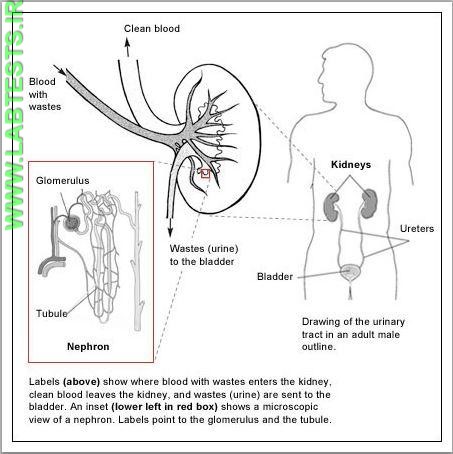
Image credit: National Institute of Diabetes and Digestive and Kidney Diseases


