

To help evaluate thyroid gland function; to diagnose thyroid disease, including hyperthyroidism, and determine the cause; to monitor effectiveness of treatment of a thyroid disorder
Free T3 and Total T3
Free T3 and Total T3
Also Known As
FT3
Triiodothyronine
Formal Name
Free Triiodothyronine; Total Triiodothyronine
This article was last reviewed
on
This article waslast modified
on November 2, 2017.
At a Glance
Why Get Tested?
Sample Required?
A blood sample taken from a vein in your arm
Test Preparation Needed?
None needed; however, certain medications can interfere with the free T3 and total T3 tests, so tell your health practitioner about any drugs that you are taking.
Accordion Title
Common Questions
-
How is it used?
A free or total triiodothyronine (free T3 or total T3) test is used to assess thyroid function. It is ordered primarily to help diagnose hyperthyroidism and may be ordered to help monitor treatment of a person with a known thyroid disorder.
T3 and T4 (thyroxine) are hormones produced by the thyroid gland. They help control the rate at which the body uses energy and are regulated by a feedback system. Thyroid-stimulating hormone (TSH) stimulates the production and release of T4 (primarily) and T3. As needed, T4 is converted into T3 by the liver and other tissues.
Most of the T4 and T3 circulates in the blood bound to protein, while a small percentage is free (not bound). Blood tests can measure total T4 (unbound plus bound), free T4, total T3 (bound plus unbound), or free T3.
Since most T3 is bound to protein, the total T3 can be affected by protein levels and protein binding ability, but the free T3 is not. However, some professional guidelines recommend the total T3, so either test may be used to assess thyroid function. For example, free T3 or sometimes total T3 may be ordered along with thyroid antibodies to help diagnose Graves disease, an autoimmune disorder that is the most common cause of hyperthyroidism.
The free or total T3 test is usually ordered following an abnormal TSH, particularly if the free T4 test is not elevated.
-
When is it ordered?
A free T3 or total T3 test may be ordered when someone has an abnormal TSH test result. It may be ordered as part of the investigative workup when a person has symptoms suggesting hyperthyroidism, especially if the free T4 level is not elevated.
Signs and symptoms may include:
- Increased heart rate
- Anxiety
- Weight loss
- Difficulty sleeping
- Tremors in the hands
- Weakness
- Diarrhea (sometimes)
- Light sensitivity, visual disturbances
- The eyes may be affected: puffiness around the eyes, dryness, irritation, and, in some cases, bulging of the eyes.
Free or total T3 may sometimes be ordered at intervals to monitor a known thyroid condition and to help monitor the effectiveness of treatment for hyperthyroidism.
-
What does the test result mean?
Increased or decreased thyroid hormone results indicate that there is an imbalance between the body's requirements and supply, but they do not tell the health practitioner specifically what is causing the excess or deficiency.
The following table summarizes some examples of typical test results and their potential meaning.
TSH free T4 free or total T3 probable Interpretation High Normal Normal Mild (subclinical) hypothyroidism High Low Low or normal Hypothyroidism Low Normal Normal Mild (subclinical) hyperthyroidism Low High or normal High or normal Hyperthyroidism Low Low or normal Low or normal Non-thyroidal illness; rare pituitary (secondary) hypothyroidism Normal High High Thyroid hormone resistance syndrome (a mutation in the thyroid hormone receptor decreases thyroid hormone function) If someone is being treated with anti-thyroid medication for hyperthyroidism and the free or total T3 (or more frequently, the free T4 or TSH) is normal, then it is likely that the medication is effective in treating the condition. If the free or total T3 or free T4 is elevated, then the medication is not effective in treating the condition and the person may be experiencing symptoms associated with hyperthyroidism.
-
Is there anything else I should know?
It is generally recommended that thyroid testing be avoided in hospitalized patients or deferred until after a person has recovered from an acute illness since thyroid hormone levels may be affected the stress of an illness. When someone is sick, the body decreases production of T3 from T4. Most people who are sick enough to be in the hospital will have a low T3 or free T3 level. For this reason, health practitioners usually only order T3 tests in outpatient settings.
It is important to note that thyroid tests are a "snapshot" of what is occurring within a dynamic system. An individual person's total T3, free T3, total T4, free T4, and/or TSH results may vary and may be affected by:
- Increases, decreases, and changes (inherited or acquired) in the proteins that bind T4 and T3
- Pregnancy
- Estrogen and other drugs
- Liver disease
- Systemic illness
- Resistance to thyroid hormones
Many medications—including estrogen, certain types of birth control pills, and large doses of aspirin—can affect total T3 test results and their use should be discussed with a health practitioner prior to testing. In general, free T3 levels are not affected by these medications.
-
How does pregnancy affect thyroid hormone levels?
Pregnancy can increase total and free T3 levels although it does not mean that thyroid disease will develop. For more information, see the Thyroid Foundation of America's web page Thyroid Problems During and After Pregnancy - Are You At Risk?
-
What is the T3 uptake test?
This test was once used to help calculate the Free Thyroxine Index (FTI), an estimation of the free T4 concentration. It is determined from the total T4 test and some estimation of the level of thyroid hormone binding proteins. The T3 uptake test was the original test for estimating the level of binding proteins, and later versions were called T-uptake methods. These are rarely used now that there are methods available to measure free T4 and free T3 directly.
-
What is reverse T3?
Reverse T3 (RT3 or REVT3) is a biologically inactive form of T3. Normally, when the liver converts T4 to T3, it also produces a certain percentage of RT3. When the body is under stress, such as during a serious illness, it tries to prevent many tissues that depend on T3 from being metabolically active by producing more RT3 than T3. This is believed to be a way of conserving energy until the stress is relieved and it causes a syndrome called non-thyroidal illness (NTI). RT3 may also be elevated in hyperthyroidism. Use of the RT3 test remains controversial and it is not widely requested.
Related Images

View More
0787.jpg?itok=kv96XY0z)
Location of the thyroid. Don Bliss, National Cancer Institute

View More
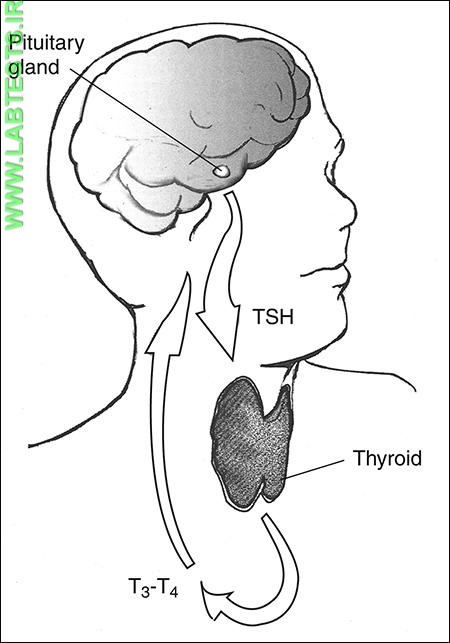
The thyroid gland’s production of thyroid hormones is regulated by thyroid-stimulating hormone (TSH). Arrows show the direction of TSH from the pituitary gland to the thyroid gland and of T3 and T4 from the thyroid to the pituitary gland. Credit: NIDDK


