

To detect chromosome abnormalities, thus to help diagnose genetic diseases, some birth defects, and certain disorders of the blood and lymphatic system
Chromosome Analysis (Karyotyping)
Chromosome Analysis (Karyotyping)
Also Known As
Karyotype
Cytogenetics
Cytogenetic Analysis
Chromosome Studies
Chromosome Karyotype
Formal Name
Chromosome Analysis
This article was last reviewed
on
This article waslast modified
on January 11, 2018.
At a Glance
Why Get Tested?
When To Get Tested?
When pregnancy screening tests are abnormal; whenever signs of a chromosomal abnormality-associated disorder are present; as indicated to detect chromosomal abnormalities in a person and/or detect a specific abnormality in family members; sometimes when a person has leukemia, lymphoma, myeloma, myelodysplasia or another cancer and an acquired chromosome abnormality is suspected
Sample Required?
A blood sample drawn from a vein in your arm; a sample of amniotic fluid or chorionic villus from a pregnant woman; a bone marrow or tissue sample
Test Preparation Needed?
None
Accordion Title
Common Questions
-
How is it used?
A chromosomal karyotype is used to detect chromosome abnormalities and thus used to diagnose genetic diseases, some birth defects, and certain disorders of the blood or lymphatic system.
It may be performed for:
- A fetus, using amniotic fluid or chorionic villi (tissue from the placenta):
- If one or more of a woman's pregnancy screening tests, such as the first trimester Down syndrome screen or the second trimester maternal serum screening, are abnormal.
- If a pregnant woman is having amniotic fluid analysis performed because she is considered at higher than normal risk of having a baby with a birth defect.
- If fetal structural and/or developmental abnormalities are detected, such as during an ultrasound.
- If there is a known chromosomal abnormality in the family line.
- A woman or a couple, prior to pregnancy, to evaluate her or their chromosomes, especially if a woman has experienced previous miscarriages or infertility.
- Tissue from a miscarriage or stillbirth, to help determine if the cause was due to a chromosomal abnormality in the fetus.
- An infant who is born with congenital abnormalities, including physical birth defects, mental retardation, delayed growth and development, or signs of a specific genetic disorder.
- A person with infertility or one who shows signs of a genetic disorder.
- Family members, to detect specific chromosomal abnormalities when they have been detected in a child or another family member.
- A person who has been diagnosed with certain types of leukemia, lymphoma, refractory anemia, or cancer as these conditions can lead to acquired changes in chromosomes; this testing may be performed on blood or a bone marrow sample.
- A fetus, using amniotic fluid or chorionic villi (tissue from the placenta):
-
When is it ordered?
A chromosome analysis may be ordered when a fetus is suspected of having a chromosomal abnormality, when an infant has congenital abnormalities, when a woman experiences miscarriages or infertility, and when an adult shows signs of a genetic disorder.
It may also be ordered to detect the presence of a chromosomal abnormality in family members when it has been detected in a child or in another family member.
It may be ordered to detect acquired chromosomal abnormalities when an individual has leukemia, lymphoma, myeloma, refractory anemia, or another cancer.
-
What does the test result mean?
Interpretation of test results must be done by a person with specialized training in cytogenetics. Some findings are relatively straightforward, such as an extra chromosome 21 (Trisomy 21) indicating Down syndrome, but others may be very complex.
Although there will be typical signs with specific chromosomal abnormalities, the effects and the severity may vary from person to person and often cannot be reliably predicted.
Some examples of abnormalities that chromosome analysis may reveal include:
Trisomy This is the presence of an extra chromosome, a third instead of a pair. Diseases associated with trisomies include Down syndrome (associated with a Trisomy of chromosome 21), Patau syndrome (Trisomy 13), Edward syndrome (Trisomy 18), and Klinefelter syndrome (a male with an extra X chromosome – XXY instead of XY). Monosomy This is the absence of one of the chromosomes. An example of monosomy is Turner syndrome (a female with a single X chromosome – X instead of XX). Most other monosomies are not compatible with life. Deletions These are missing pieces of chromosomes and/or genetic material. Some may be small and difficult to be detected. Duplications These represent extra genetic material and may be present on any chromosome, such as the presence of two horizontal bands at a specific location instead of one. Translocations With translocations, pieces of chromosomes break off and reattach to another chromosome. If it is a one-to-one switch and all of the genetic material is present (but in the wrong place), it is said to be a balanced translocation. If it is not, then it is called an unbalanced translocation. Genetic Rearrangement With this, genetic material is present on a chromosome but not in its usual location. A person could have both rearrangement and duplication or deletion. An almost infinite number of rearrangements are possible. Interpreting the affects of the changes can be challenging. Duplications, deletions, translocations, and genetic rearrangements can cause a myriad of health and development issues. It depends upon what genes are missing or are present in too many copies.
Some genetic rearrangements will be variations that do not cause noticeable symptoms. Balanced translocations (where two chromosomes have swapped portions of themselves but all of the genetic material is present) may cause no problems for the person who has them but may cause problems in their children.
Many hematologic and lymphoid malignancies (e.g., leukemia, lymphoma, myeloma, myelodysplasia) are associated with chromosomal abnormalities, which can help diagnose the disease and/or predict the clinical course of the disease.
-
Is there anything else I should know?
Since the sex chromosomes (XX or XY) are identified during the chromosome analysis, this test will also, as a byproduct, definitely determine the sex of a fetus.
Some chromosome alterations are too small or subtle to detect with karyotyping. Other testing technique such as fluorescent in situ hybridization (FISH) or a microarray may sometimes be performed to further investigate chromosomal abnormalities.
It is possible for people to have cells in their body with differing genetic material. This happens because of changes early in the development of a fetus that lead to the development of distinctly different cell lines and is called mosaicism. An example of this is some cases of Down syndrome. The affected person can have some cells with an extra third chromosome 21 and some cells with the normal pair.
-
Should everyone have this testing done?
Chromosome analysis is frequently performed, but it is not indicated as a general screening test. The majority of people will never need to have one done.
-
Can a chromosome analysis be performed in my healthcare provider's office?
No, it requires specialized equipment to perform and expertise to interpret. In most cases, samples will be sent to a reference laboratory.
-
Why does the karyotype take several days to perform?
The cells that are tested must be cultured and cell division promoted. The amount of time that this takes will vary from sample to sample. Highly complex, abnormal karyotypes may require a longer time to evaluate.
Related Images

View More

Example of a peripheral blood karyotype, normal male. Courtesy of: Mary Lowery Nordberg, PhD

View More

Example of an abnormal karyotype showing an extra chromosome 21 (Trisomy 21) indicative of Down syndrome. Courtesy of: Mary Lowery Nordberg, PhD

View More
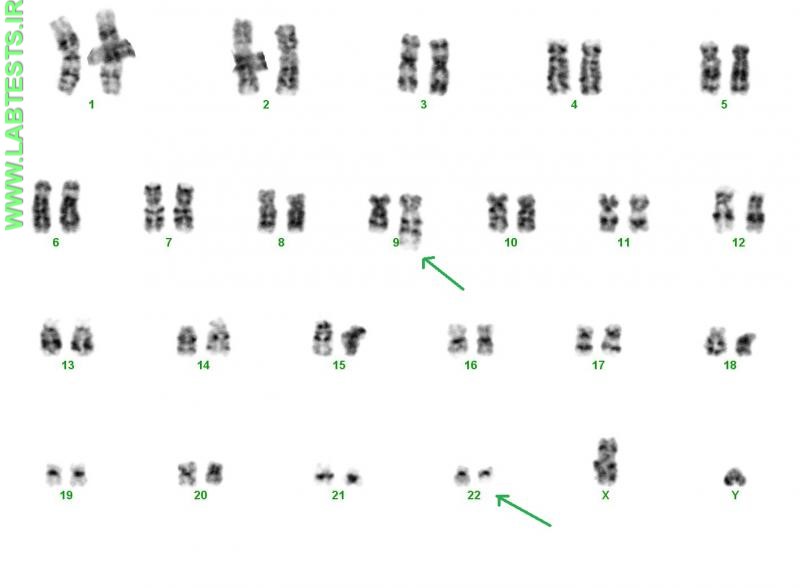
Example of an abnormal bone marrow karyotype showing chromosome 9 and chromosome 22 (9;22) rearrangement, indicative of chronic myelogenous leukemia (CML) or a subtype of acute lymphoblastic leukemia (ALL) Courtesy of: Mary Lowery Nordberg, PhD


